
The most amazing thing for me is that every single person who sees a movie brings a whole set of unique experiences. Through careful manipulation & good storytelling you can get everybody to clap at the same time, to hopefully laugh at the same time, and to be afraid at the same time. – Steven Spielberg
“Stay tuned for the Top 10…coming…soon-ish.” That’s what I said at the end of the previous installment of this series…a little over a year ago. There’s been a lot of water under the bridge since then, but this isn’t the time to dive down that rabbit hole. At this moment I just want to finish what I started way back in October 2019. As I’m sure you’ll want a little refresher please check out how we got to this point by going here, here, here, here, & here. It’s good to be back.
10 Forrest Gump (Forrest Gump)

An unnamed person, in a conversation with legendary college football coach Bear Bryant, describes the titular character in 1994’s Best Picture simply & succinctly as “a local idiot”. Of course he is so much more. It is my understanding that the film is significantly different in tone from the book it is based on, but either way it is a flight of fancy in which the aforementioned idiot finds himself in a number of inexplicable situations, from playing college football at Alabama to becoming a war hero to blowing the whistle on Watergate burglars to owning his own shrimping business. Forrest isn’t completely oblivious, and he has a level of common sense that would be the envy of many real life individuals nowadays. He loves his Mama and meets his girl Jenny in grade school, although it takes her a few decades to return his affection. Those two ladies are all he really cares about until he gets to Vietnam and meets his buddy Bubba, whose life is cut tragically short, and Lt. Dan, who eventually becomes his best friend & business partner. Tom Hanks won his second consecutive Academy Award for Best Actor for the role, and we all should be thankful he got the part after John Travolta, Bill Murray, Chevy Chase, and Sean Penn all allegedly passed on it.
Quotes
“Mama always said ‘Life is like a box of chocolates…you never know what you’re gonna get’.”
“Jenny and me was like peas & carrots.”
“Mama says stupid is as stupid does.”
“I never went back to work for Lieutenant Dan, though he did take care of my Bubba-Gump money. He got me invested in some kind of fruit company. And so then I got a call from him saying we don’t have to worry about money no more. And I said ‘That’s good…one less thing’.”
“I’m not a smart man, but I know what love is.”
“I don’t know if Mama was right or if it’s Lt. Dan. I don’t know if we each have a destiny, or if we’re all just floating around accidental-like on a breeze, but I think maybe it’s both happening at the same time.”
9 Dorothy Gale (The Wizard of Oz)
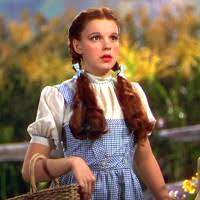
Judy Garland was 16 years old when she portrayed Dorothy in the 1939 classic, which was an annual television tradition when I was a kid (a quaint notion these days). Garland starred in dozens of films in a career that spanned four decades (remarkable when you considered she passed on at the young age of 47), but she’ll always be remembered as Dorothy, a Kansas farm girl who gets caught in a tornado and either has a really cool dream or actually goes to a fantasy land called Oz, depending on one’s interpretation of the movie. L. Frank Baum wrote 14 novels about Oz, which means that we missed out on a bunch of potential sequels. I guess Hollywood did business a whole lot different back then. At any rate, Garland’s talents as a singer & actress, as well as her youthful innocence, made her the perfect choice for the role.
Quotes
“Toto, I’ve got a feeling we’re not in Kansas anymore.”
“Lions, and tigers, and bears! Oh my!”
“There’s no place like home.”
8 Batman, Superman, & Spider-Man (various films)

I’m not a comic book guy…never was, even as a little boy. However, superheroes are such a ubiquitous part of the pop culture landscape that there are plenty of ways to become familiar with and be entertained by the plethora of adventures they engage in. Though it might be a fun debate I am fairly certain that most would consider the Big Three superheroes to be Batman, Superman, & Spider-Man. My particular favorite has always been Batman, precisely for the reason that some question his status as a superhero at all. He’s not an alien. His body hasn’t been genetically altered in any way. He doesn’t have any kind of magic powers. Batman is simply a mega rich business mogul who has dedicated his life to vigilante justice because he is psychologically damaged after watching his parents get murdered when he was a little boy. I dare you to come up with cooler origin story. Superman is an “undocumented worker” from the planet Krypton whose spaceship lands in Kansas. After growing up on the farm he becomes a big city reporter, but when he takes his glasses off & uses a phone booth to change into his red caped costume he becomes indestructible, has x-ray vision, and can fly. Spider-Man is a typical American teenager who is bitten by a radioactive spider and develops all kinds of cool powers, including the ability to shoot webs from his wrist that help him to scale tall buildings & fly. He decides to use his unique skills to bring bad guys to justice after his Uncle Ben is shot by a street thug. Our three superheroes have starred in dozens of movies & TV shows. My favorite big screen Caped Crusader was portrayed by Michael Keaton in the late 80s Tim Burton films. As far as I’m concerned the late Christopher Reeve will always embody Superman. And though I am pretty fond of Tobey Maguire’s version of Spider-Man from a couple of decades ago I have to say that the current incarnation as presented by the Marvel Cinematic Universe is quite entertaining.
Quotes
“Maybe that’s what Batman is about. Not winning, but failing and getting back up. Knowing he’ll fail, fail a thousand times, but still won’t give up.” – Batman
“No matter where you go in life there’s always going to be the one person that wants to bring you down, so stay strong and face your problems instead of running away.” – Superman
“Not everyone is meant to make a difference. But for me, the choice to lead an ordinary life is no longer an option.” – Spiderman
7 Gordon Gekko (Wall Street)

Gordon Gekko represents a moment in time, or atleast some people’s perspective of that particular era. Were the 1980s a Decade of Greed, wherein the populace engaged in intense levels of conspicuous consumption?? Certainly pop culture embraced that mythology, with TV shows like Dallas & Dynasty and movies ranging from Trading Places & Arthur to Scarface & St. Elmo’s Fire. Yuppies drinking Perrier on their yachts while constantly checking in with their stock broker were a popular stereotype. Class warfare was encouraged. Did any of that have a legit connection to the real world?? Certainly the economy was robust in the 80s, but as a kid in small town West Virginia I never encountered those kinds of people. Unlike preconceived notions of Appalachia our family wore shoes, had indoor plumbing, & didn’t have vehicles on blocks in our front yard, yet we definitely weren’t wealthy. At any rate, even if folks like Gordon Gekko were rare Michael Douglas made him seem very real, sort of cool, & really interesting. His return in the 2010 sequel Wall Street: Money Never Sleeps probably came about a decade too late, but it was still fun to see him onscreen again.
Quotes
“The most valuable commodity I know of is information.”
“What’s worth doing is worth doing for money.”
“Gimme guys who are poor, smart, & hungry. And no feelings. You win some, you lose some, but you keep on fighting. And if you need a friend, get a dog.”
“I am not a destroyer of companies. I am a liberator of them! The point is, ladies & gentlemen, that greed, for lack of a better word, is good. Greed is right, greed works. Greed clarifies, cuts through, and captures the essence of the evolutionary spirit. Greed, in all its forms: greed for life, for money, for love, knowledge, has marked the upward surge of mankind.”
“It’s a zero sum game. Somebody wins, somebody loses. Money itself isn’t lost or made, it’s simply transferred from one perception to another. Like magic.”
“You got 99% of the American public out there with little or no net worth. I create nothing. I own. We make the rules, pal. The news, war, peace, famine, upheaval, the price per paper clip. We pick that rabbit out of the hat while everybody sits out there wondering how the hell we did it.”
6 Marty McFly & Doc Brown (The Back to the Future Trilogy)

I don’t think there’s any way to separate the pair. They are peanut butter & jelly, Bert & Ernie, peas & carrots…one without the other just isn’t right. I am a huge fan of the Back to the Future Trilogy. I assume most people have some level of familiarity with the franchise, but just in case I’ll refresh your memory. Marty is a typical California teen in the 1980s with a family that he finds slightly embarrassing. Dr. Emmett Brown is an eccentric scientist who builds a time machine out of a DeLorean. Marty accidentally gets sent back in time to the 1950s, inadvertently screws up the space-time continuum, jeopardizing his parents relationship and therefore his own existence. It’s pretty heavy. Throughout three very entertaining films Doc & Marty take us from the 1980s to the 1950s to the 21st Century and even the Old West. Michael J. Fox wasn’t even the original Marty, but when actor Eric Stoltz just didn’t click in the role he was replaced, and thank God for that. BTTF is just the right mix of fun, adventure, suspense, & romance, and Doc & Marty are the centerpiece.
Quotes
“If my calculations are correct, when this baby hits 88 miles per hour, you’re gonna see some serious shit.” (Doc)
“Whoa, wait a minute, Doc. Are you trying to tell me that my mother has got the hots for me?” (Marty)
“Why are things so heavy in the future? Is there a problem with the Earth’s gravitational pull?” (Doc)
“I guess you guys aren’t ready for that, yet. But your kids are gonna love it.” (Marty)
“Great Scott!” (Doc)
“So, you’re my Uncle Joey. Better get used to these bars, kid.” (Marty)
“Roads? Where we’re going, we don’t need roads.” (Doc)
“Time traveling is just too dangerous. Better that I devote myself to study the other great mystery of the universe: women.” (Doc)
“Your future hasn’t been written yet. No one’s has. Your future is whatever you make it, so make it a good one.” (Doc)
5 Rocky Balboa (The Rocky Series)

When ranking my favorite sports films several years ago I opined that Rocky redefined the genre. It was the first sports movie to win the Academy Award for Best Picture (only two others have achieved that feat since) and was actually written by Sylvester Stallone. Hollywood power brokers wanted a known entity like James Caan or Burt Reynolds to play the lead because at the time, in the mid-1970s, Stallone was a nobody. The fact that Stallone not only got the part but received an Oscar nomination and created an iconic character in the process actually mirrors the plot of the film. I like the other actors considered for the role just fine, but Stallone portrays Rocky in such a way that we see ourselves in him. He’s not rich or successful. He isn’t a well-spoken intellectual. He’s just a guy from the neighborhood doing what he can to get by and chasing a dream in his spare time. The fact that he succeeds (eventually) and builds a great life for himself & his family gives the rest of us hope that we can do the same.
Quotes
“She’s got gaps, I got gaps. Together, we fill gaps.”
“Yo Adrian! I did it!!’
“If I can change, and you can change, everybody can change!”
“The world ain’t all sunshine & rainbows. It’s a very mean & nasty place, and I don’t care how tough you are, it will beat you to your knees and keep you there permanently if you let it. You, me, or nobody is gonna hit as hard as life. But it ain’t about how hard you hit. It’s about how hard you can get hit and keep moving forward; how much you can take and keep moving forward. That’s how winning is done!”
4 Darth Vader (The Star Wars Series)

Has there ever been a more iconic cinematic badass?? The costume. The mask. The voice. Put Vader in a cage with Freddy Krueger, Jason Voorhees, Michael Myers, and any other lunatic in the history of film and I’m guessing he’d hold his own. The question is, did the prequels ruin his story?? Aside from the weak writing and poor casting that lessened the impact of the prequel trilogy I’m going to say no…Darth Vader is still Darth Vader. I view Anakin Skywalker as a different character altogether. At the end of Rogue One (a criminally underappreciated film that’s better than any of the prequels) Vader has a brief yet effectual appearance that’ll make the hair on your neck stand up, but nothing beats that moment in The Empire Strikes Back when he drops the biggest truth bomb ever on Luke Skywalker. That scene is still quoted & parodied more than four decades later, which is quite a legacy.
Quotes
“I find your lack of faith disturbing.”
“Join me, and I will complete your training. With our combined strength, we can end this destructive conflict, and bring order to the galaxy.”
“I am your father! Join me, and together we can rule the galaxy as father & son!”
“Obi-Wan has taught you well.”
“You under estimate the power of the dark side. If you will not fight, then you will meet your destiny!”
3 Rick Blaine (Casablanca)
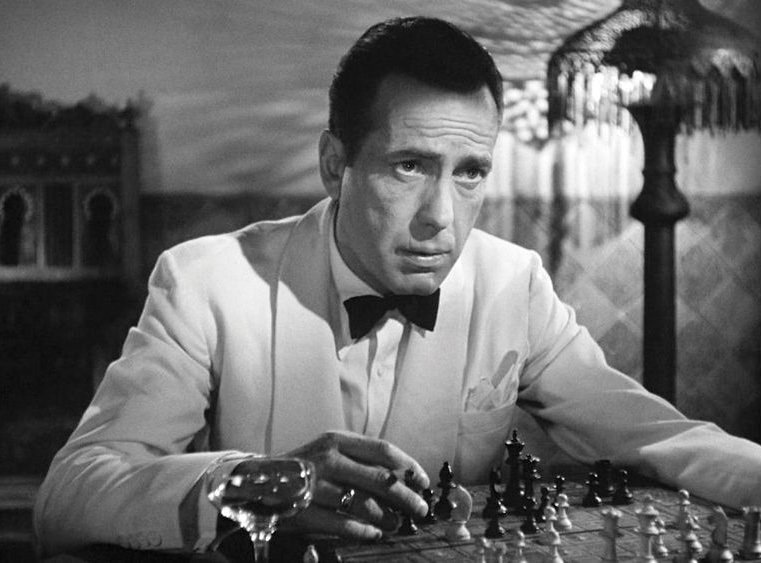
Do men like Rick even exist anymore?? Cool. Smart. Pragmatic. Mysterious. Debonair. A rare mix of romantic & jaded. He’s the kind of guy that makes women swoon yet men can’t help but respect & admire. His aloof demeanor hides a principled heart of gold. He owns a nightclub in Morocco that people flock to during WWII to forget about war for awhile. People from all walks of life & all nationalities (including Nazis) are welcome at Rick’s Cafe Americain because he’s a businessman who’ll gladly take anybody’s money. Perhaps men like Rick don’t exist anymore because they never did in the first place. Rick Blaine is an idealistic notion of what a man should be, and there are worse characters one could emulate.
Quotes
“Of all the gin joints in all the towns in all the world, she walks into mine.”
“I stick my neck out for nobody.”
“When it comes to women, you’re a true Democrat.”
“I don’t mind a parasite. I object to a cut-rate one.”
“I’m not fighting for anything anymore except myself. I’m the only cause I’m interested in.”
“If that plane leaves the ground and you’re not with him, you’ll regret it. Maybe not today, maybe not tomorrow, but soon and for the rest of your life. We’ll always have Paris. I’m no good at being noble, but it doesn’t take much to see that the problems of three little people don’t amount to a hill of beans in this crazy world. Someday you’ll understand that. Here’s looking at you, kid.”
“Louis, I think this is the beginning of a beautiful friendship.”
2 Atticus Finch (To Kill a Mockingbird)

It is rare that an attorney is viewed as a role model even in fiction, but Atticus Finch is the ultimate quixotic fantasy. Not only is he the most virtuous lawyer ever, but he’s the epitome of a perfect father. Modern audiences tend to prefer anti-heroes, or atleast a flawed protagonist in which we recognize our own imperfections and soothe ourselves with the notion that it’s okay to be a little messed up. We scoff at ideals like integrity, honor, ethics, loyalty, & altruism. That being said, is it really that bad to have such a measuring stick in our fiction?? On top of all that let me remind you of something I stated two years ago when we began this journey: “the value of a character’s name cannot be overstated”. How cool & memorable is the name Atticus Finch?? As usual I urge everyone to read To Kill A Mockingbird. It is one of my favorite books and most agree it is amongst the finest novels ever written. But we are discussing movie characters here, right?? The book had already won the 1962 Pulitzer Prize, so adapting it into a film just a year later had to have been a daunting task. Gregory Peck had already been nominated for four Academy Awards in the 1940s, so the powers-that-be knew what they were doing. It turned out better than anyone could have ever dreamed, with Peck beating out Burt Lancaster, Jack Lemmon, & Peter O’Toole to win his only Oscar.
Quotes
“You never really understand a person until you consider things from his point of view…until you climb inside of his skin and walk around in it.”
“In this country our courts are the great levelers. In our courts all men are created equal. I’m no idealist to believe firmly in the integrity of our courts and of our jury system…that’s no ideal to me. That is a living, working reality.”
“I remember when my Daddy gave me that gun. He told me that I should never point it at anything in the house, and that he’d rather I’d shoot at tin cans in the backyard. But he said that sooner or later he supposed the temptation to go after birds would be too much, and that I could shoot all the blue jays I wanted, if I could hit ’em, but to remember it was a sin to kill a mockingbird. Mockingbirds don’t do anything but make music for us to enjoy. They don’t eat people’s gardens, don’t nest in the corncribs. They don’t do one thing but just sing their hearts out for us.”
1 Michael Corleone (The Godfather Trilogy)

We’ve reached the pinnacle, and I am contradicting myself one last time…or am I?? When discussing Pacino’s portrayal of Lt. Col. Frank Slade I opined that, while The Godfather is his best film, Slade is his best performance. I stand by that because there is a difference. Michael Corleone is a much more memorable character, especially since he has an entire trilogy to impact our pop culture consciousness. That influence is made all the more impressive when considering the fact that Pacino shares the screen with Marlon Brando & James Caan in the original film, Part 2 is focused on Robert Deniro’s depiction of young Vito Corleone, and so many people despise Part 3 (I don’t hate it). But the one constant flowing thru all three Godfather films is Michael Corleone. He is introduced as a young war hero in a new romance, then reluctantly gets pulled into the family business. Finding that he has a knack for ruthlessness Michael evolves into a stone cold killer and merciless husband, even having his own brother murdered. As he grows old & ill he becomes consumed with regret and concerned with his legacy, his story ending with one of the more depressing deaths in cinema. The evolution of Michael Corleone is well written & performed and remarkably sad.
Quotes
“My father made him an offer he couldn’t refuse. Luca Brasi held a gun to his head and my father assured him that either his brains or his signature would be on the contract. That’s a true story. That’s my family, Kay. It’s not me.”
‘It’s not personal, Sonny. It’s strictly business.’
“Don’t ever take sides with anyone against the family again, ever.”
“Today, I settle all family business, so don’t tell me you’re innocent because it insults my intelligence. It makes me very angry.”
“I know it was you, Fredo. You broke my heart. You broke my heart!”
“My father taught me many things here. He taught me to keep your friends close but your enemies closer.”
“You’re nothing to me now. You’re not a brother, you’re not a friend. I don’t want to know you or what you do. I don’t want to see you at the hotels. I don’t want you near my house. When you see our mother, I want to know a day in advance so I won’t be there.”
“Never hate your enemies. It affects your judgment.”
“I command this family, right or wrong. It was not what I wanted!”
“Just when I thought I was out, they pull me back in!”



















 through the prism of the viewing public it is difficult to not fall into the trap of being lazy, repetitive, and uninspired. Too often we see sequels that are just retreads of the original…same stunts, same gags, same jokes, same effects. Or worse yet, the powers-that-be try to make a sequel where few of the original actors or characters remain and they are only borrowing a broad concept or theme with very loose ties to its predecessor. The Godfather Part II is not a victim of any of these issues. It is quite possibly the greatest sequel ever made. It was the first sequel to win the
  Robert Duval, and Diane Keaton returning from the first film and acting legend Lee Strasberg coming out of retirement to portray Hyman Roth. My favorite character though might be Frank Pentangeli, a Corleone family caporegime who replaces Clemenza, a development dictated by a dispute with the actor who played Clemenza. Frankie Five Angels is just tremendous…funny, ham-handed, erratic, and most of all unique. I am not sure Part II would have been quite as good with Clemenza as it ends up being with Pentageli. The flashback sequences with the younger Vito are done completely in Italian, a risky move by director
  I know I have said it before but it bears repeating…I am not an action flick aficionado. Most anything starring Stallone, Schwarzenegger, Van Damme, Seagal, or Chuck Norris just doesn’t frost my cupcake. I have never seen a James Bond film in its entirety. Indiana Jones has never graced a screen big or small in my presence. But as with any rule there are exceptions, and this is the biggest one of them all. 1988’s Die Hard finds Bruce Willis starring as John McClane, a NY City cop whose marriage is on the rocks because his wife took a corporate gig in Los Angeles and now lives there with the kids, estranged from her husband. She invites him out to the Left Coast for Christmas to visit the children and maybe smooth things out. However, upon arriving at the wife’s company Christmas bash near the top of an unfinished skyscraper McClane finds himself the lone wolf fighting against a contingent of foreign terrorists who invade the party, kill the CEO, and hold everyone else hostage. The bad guys are unaware of McClane’s presence and even when he does make himself known he does not reveal that he has the skills to fight back. Soon enough the LAPD and the FBI are involved. There is lots of shooting and explosions, but thankfully they are accompanied by a good story and surprising levity for an action movie. I think maybe that’s why I like it…the humor sets Die Hard apart from others in the genre, who tend to take themselves too seriously. Don’t misunderstand…Die Hard is a serious movie about terrorism and one man’s battle to save the life of his beloved wife, but along the way we get airheaded FBI agents (agent Johnson and Special Agent Johnson), a limo driver that personifies the generation gap between himself and McClane, and the Dad from Family Matters, an 80’s sitcom best known for its nerdy star Urkel, who bonds with McClane over the two-way radio. We also get Hans Gruber, one of the most memorable villains in movie history. Gruber is portrayed by Alan Rickman, who is widely known today as Professor Snape in the Harry Potter films. But in 1988 he was an unknown who ended up creating such a great character. It is implied that Gruber is a ticked off German who has taken over Nakatomi Plaza for political reasons. However, we eventually learn that he is nothing more than a thief whose goal is to steal a half billion dollars worth of bonds, destroy the building making everyone think the terrorists perished as well, and escape with the loot. It is an ingenious plan, and Gruber seems to know everything that will happen. He especially knows the playbook of the police and the feds, who are portrayed as predictable buffoons. But what he and his men don’t plan on is the “fly in
  the ointment” named John McClane. Willis was a television star at the time, coming into our living rooms each week alongside Cybill Shepherd in the detective rom-com Moonlighting. He had done a few forgettable films, but it was Die Hard that made him a star and he has continued to ride the wave for over 20 years. Die Hard, in my opinion, is the gold standard of action movies. It has just the right mix of drama, action, humor, suspense, good writing, and excellent performances. It is not gratuitously bloody, and it is just plausible enough for the viewer to suspend disbelief and become engrossed in the story and characters. 1988 was, of course, long before the tragic events of September 11, 2001, and for that I am thankful if only because Die Hard would likely never get made in a post-9/11 world. McClane has resurfaced in three sequels with plans for yet another, but those efforts have been hit & miss. I keep using the phrase “lightning in a bottle”, and it applies here as well. Countless films have borrowed elements of Die Hard in the last two decades, and I suppose imitation is the sincerest form of flattery. But I have yet to stumble upon a knockoff that comes anywhere close to being as good as the original.
 Yes, I know…I am kinda sorta cheating just one more time. In pondering the three original
  anticipation reached a fever pitch. People waited in line days in advance for tickets. Unfortunately the prequels did not live up to their predecessors, but honestly how could they?? They aren’t really bad films, especially the third, but there was no way they could possibly approach the greatness of the original trilogy. Every new generation that is introduced to The
  This is what NFL scouts might call at quick riser, a movie that has improved its stock the most in the shortest amount of time. Released in 1995 and based on the true story of NASA’s 1970 “successful failure”, Apollo 13 is a film that I honestly didn’t pay that much attention to when it first came out. Looking back I have to assume that is due to the timing. June of 1995 was a bad month, one that I look back on almost daily as a negative turning point in my life. So I guess I was engrossed in my own drama and didn’t make it a priority to go to the theater and pay money to watch tragic events of others’ lives. But over the course of the past 10 years I have discovered its greatness and become familiar with the real life situation. Directed by Ron Howard and starring Tom Hanks, Kevin Bacon, and Bill Paxton as astronauts whose planned mission to land on the moon goes horribly awry, Apollo 13 is just the sort of movie I can truly embrace. It is beautifully written, has understated, moving performances, and the direction by Ron Howard is magnificent. I don’t usually recognize the function of the director because honestly I am not familiar enough with what a director really does and what his/her role is in the final product. But here one can easily see that this story, in the hands of someone else…maybe James Cameron (Terminator, Titanic), Renny Harlin (Cliffhanger, Die Hard 2), Ridley Scott (Blade Runner, Gladiator), Quentin Tarantino (Pulp Fiction, Reservoir Dogs), or God forbid as a Michael Bay/Jerry Bruckheimer production (Bad Boys, Pearl Harbor)…would have been completely different and likely lacked the
  subtlety and class brought into the mix by Howard, aka Lil Opie Cunningham, who turns it into something better than a cookie cutter action flick. Two supporting performances, Ed Harris as flight director Gene Kranz and Kathleen Quinlan as astronaut wife Marilyn Lovell, were nominated for Academy Awards. The film itself was nominated for Best Picture and Howard for Best Director. Somehow all four of these awards went to others. Braveheart won Best Picture and its director, Mel Gibson, won that award. Kevin Spacey was Best Supporting Actor for his role as Keyser Soze/Verbal Kint in The Usual Suspects. And Mira Sorvino was Best Supporting Actress in some movie no one remembers. I suppose many may disagree, but it is my contention that Apollo 13 was robbed and should have won atleast 3 of these 4 awards. Harris’ performance is especially exceptional and cemented his status as one of Hollywood’s most underappreciated actors. Various television stations show Apollo 13 quite often, and I almost always stop whatever I am doing to watch, which in my mind is the mark of a really good movie. There is a scene near the end of the film where the fate of the astronauts is in question for about 3 minutes. This plays out in real time and is very dramatic. Since this is a true story I know what happens, and even if it wasn’t a true story I have seen it enough times that I know how everything plays out…yet every single time I watch I get goosebumps and am on the edge of my seat. Now THAT is a great movie.
 The Griswold Clan, is the best in the series. But by now loyal readers know of my fierce passion for Christmas movies, and that is why Christmas Vacation ranks higher than its parent film, which is 13th on this list. Clark, Ellen, Rusty, and Audrey don’t actually go anywhere this time. They stay home to host a good old-fashioned Christmas for the extended family, which includes Clark’s parents, Ellen’s parents, and the elderly Uncle Lewis & Aunt Bethany, though their exact relationship is never explained. Showing up unexpectedly is cousin Catherine and her redneck husband Eddie, along with two of their small children. Fans of the Vacation series will recall that Catherine & Eddie and their brood make a memorable appearance in the original, and Eddie turns out to be the big star of this film. There is too much goodness for me to go into detail here, but suffice to say that Clark proves himself to be as big of a buffoon as usual, all the grandparents are nuts in that special grandparent way, and Eddie’s antics are the icing on the cake. Virtually every scene in this move has become legendary, from the oversized Christmas tree that Clark stubbornly determines is going in the living room, to Eddie cleaning out his RV’s toilet in his bathrobe, to the 25,000 lights with which Clark
  adorns the house. As a matter of fact, every December channels like HGTV and The Travel Channel have shows featuring wacky, over-the-top, gaudy Christmas light displays from across the country, and I’d be curious to know whether those kinds of garish exhibits were always around or if Christmas Vacation was the impetus for an odd new holiday tradition. I remember the first time I ever saw this movie, and there is a scene where Clark crashes a saucer sled oiled up with some sort of food varnish that he supposedly invented straight into a WalMart. At the time we did not have a WalMart in my hometown and it was just becoming a big deal. I remember thinking “Man, I wish we had a WalMart”. I laugh at that thought now since WalMart has become such a ubiquitous part of every day life. At any rate, Christmas Vacation has quickly become part of the pantheon of great Christmas movies, one of the half-dozen or so that everyone watches annually. It isn’t high art and it isn’t supposed to be. It is fairly innocuous entertainment, and that’s just fine by me.
 understanding girlfriend Kelly on Christmas Eve when he has to fly off on yet another problem solving endeavor. He tells her “I’ll be right back”, but his plane crashes and he ends up marooned on an island in the middle of nowhere. The plane crash scene is attention-grabbing and disturbingly realistic, but in a good way. A large chunk of the story is then told on the island, as we see Chuck evolve…or maybe devolve…from a harried, Type A, always on the run, white collar yuppie wannabe into a lonely, boney, grizzled survivalist. The island scenes are, in my opinion, sublime. There are long stretches with no dialogue, and it’s only the subtle, skillful craftsmanship of Tom Hanks that keeps us invested. Cast Away should be shown to every acting student in order to teach how a performer can convey so much with their eyes, small gestures, and sheer physicality. I cannot avoid spoiling things by saying that Chuck does find a way off the island after four years and is rescued. His return home is the portion of the film that is a mixed bag. On one hand I applaud the writers and director Robert Zemeckis for not giving into the temptation to give us the trite, happy ending. Kelly has moved on with her life, gotten married and had children, and that is dealt with effectively. And there is a scene where Chuck’s co-workers throw him a welcome back party complete with a smorgasbord that includes crab legs. Chuck picks one up and tosses it aside dismissively, which is absolutely exceptional. The man has just returned from a deserted island where he has eaten nothing but seafood for four years and these thoughtless jackasses put that kind of stuff on the buffet?? It is almost a throwaway moment, but for me it is one of the most memorable scenes in any movie I’ve ever seen. On the other hand, the ending leaves something to be desired. Chuck has held onto one unopened package that washed up on the island and delivers it. The note he leaves says “this package saved my life”, which I don’t get. Maybe I am just being thick, or overanalyzing. Then he comes to a crossroads…literally. The film ends with Chuck standing in the middle of a four way road with a slight grin on his face. It’s a very odd ending that I suppose was meant to have a thoughtful, ponderous tone. Instead it just leaves me…every time I watch…thinking “That’s it??”. At any rate, the film’s shortcomings are trumped by Hanks’ unforgettable performance and its “read between the lines” commentary on the value of time and the importance of priorities. I would have liked to have seen more emphasis put on what happens after Chuck’s re-entry into civilization, but that likely would have meant shaving the amount of time spent on the island scenes, which would probably lessen the overall impact.
 want, which makes him an important guy. Red becomes good friends with the newly arrived Andy, played by Tim Robbins in his only notable performance outside Bull Durham. Andy has been wrongly accused and convicted of killing his wife and her lover. He begins to become an important guy like Red by tutoring fellow inmates to get their GED and helping the guards with their taxes. The warden utilizes Andy’s skills to launder kickback money. Eventually, after 20 years, Andy escapes in a unique and unforgettable way that involves a rock hammer and a
  effeminate gay couple. We also get to meet the folks who actually produce the dog show, and the highlight is a clueless, over-the-top announcer that says things like “which one of these dogs would you want to have as your wide receiver on your football team?” and “I went to one of those obedience places once. It was all going well until they spilled hot candle wax on my private parts.” It’s all very absurd and that is kind of the point. There isn’t any message, no moral to the story, no lessons to be gleaned. It’s just a good time. Try this though…watch Best in Show and then watch one of the real dog shows. You will see just how perfectly the movie captures the essence of the actual event, and that’ll make the movie even funnier.
 separated from the pack he ends up in The Big Apple and is having a rollicking good time shacked up at the posh Plaza Hotel. But coincidentally the bumbling thieves from the first film end up in New York too, plotting to rob a toy store on Christmas Eve. Kevin discovers the plan and foils the robbery. There is an extended scene of cartoon violence just as in the first film, this time making use of an absent aunt and uncle’s currently undergoing extensive renovations home. Meanwhile the rest of the family is in Florida until the police discover that Kevin has used his Dad’s credit card in New York. The story is completely predictable and we can see the ending a mile away, but I don’t care. This is a funny movie and a holiday tradition. Is it on the same level as some of the more renowned Christmas classics?? No. I would put it a level below most of them. I could have done without the pious subplot involving the homeless pigeon lady, and the preachy toy store owner is a weak but necessary plot device. But those are small points of contention. Joe Pesci & Daniel Stern are once again sufficiently amusing as the crooks, and Rob Schneider & Tim Curry are modestly humorous as maybe the most inept hotel employees in history. The family plays its necessary part. The city itself is always an effective co-star in the myriad movies and television shows set there. I suppose my affection is, in this case, more a function of repeated viewings than possibly any other movie thus far. Lost in New York is inexplicably on random television channels throughout the year, so I have watched it a lot. I am fully aware that it isn’t high art or critically acclaimed, but it is innocuous enough and suits my tastes just fine.
 watch annually (during the appropriate season of course). Just to be clear, I am speaking of the 1978 John Carpenter original and not the fairly recent Rob Zombie “reimagining”. I haven’t seen that one yet and probably never will. Carpenter’s film introduces us to Michael Myers, who stabbed his teenage sister to death when he was six years old on Halloween night and has been in a mental institution for 15 years. He escapes…on Halloween…and returns to his hometown. In hot pursuit is the obsessed Dr. Loomis, who has been treating Michael all these years but at some point gave up because he realized the boy was “pure evil”. We also meet teenager Laurie Strode, played by Jamie Lee Curtis in what was her first film role. Michael Myers seems to have an odd fascination with Laurie Strode and stalks her throughout the movie, killing several innocent bystanders along the way. I think one of the reasons I like Halloween is because it really isn’t all that bloody, atleast by today’s standards. The producers didn’t have much of a budget, so they rely mostly on atmosphere and ambiance, and that works really well. Halloween isn’t so much gory as it is eerie and suspenseful. The story is well written and not really all that out in left field. The use of our scariest holiday is inspired and the music is perfect. I particularly enjoy Donald Pleasance as Dr. Loomis. He is borderline maniacal himself in his dogged hunt for the killer. As with so many other horror films Halloween spawned countless sequels, each one progressively more ridiculous, atleast until Jamie Lee Curtis was brought back into the mix after two decades and participated in two follow-ups that basically ignored all the insipidly silly chapters that preceded them. But even those two movies couldn’t live up to the magic of the original. Sometimes the right mix of circumstances converges and we get lightning in a bottle, and it is nearly impossible to ever repeat. Such is the case with Halloween. I would be remiss if I did not mention Halloween II, which was made 3 years after the first but the story picks up exactly where the first film left off. Michael stalks Laurie in a hospital, slowly killing various nurses and staff. We eventually learn that Laurie is Michael’s younger sister and that’s why he is after her. Michael and Dr. Loomis both supposedly die at the end, but of course death is oftentimes not permanent in the slasher genre. I just cannot put Halloween II in the list, even as a backdoor tie. The violence and gore is increased noticeably and unnecessarily, and there just seems to be something missing. It is certainly much better than the countless sequels that would follow, but not on par with its predecessor. As I said, lightning in a bottle is almost never captured again.
 Dad’s taste in women, so he calls a nationwide radio talk show on Christmas Eve and tells the host his father needs a new wife. Sam is goaded into spilling his heart to an enraptured listening public who apparently have nothing better to do on Christmas Eve. Listening intently all the way on the other side of the country in Baltimore is Annie, played by Ryan. Annie is engaged to an allergy-ridden milquetoast that she doesn’t really love and easily becomes mesmerized…and a bit obsessed…by Sam’s story. She is among the thousands of women who send Sam letters, which he somewhat cynically yet logically dismisses. She even has a background check done on him and goes to Seattle only to chicken out when their eyes lock ever so briefly. In a nod to the 1957 Cary Grant classic An Affair to Remember, the little boy (posing as his father) writes Annie and asks her to meet him at the top of the
  travel is always cool) to 1980’s San Francisco to secure some humpback whales that will save Earth in the future. The details are too contrived to explain here, and they don’t really matter anyway. What matters is that the movie becomes a delightfully humorous fish-out-of water tale (pun unavoidable), with our heroes from the 23rd century trying to maneuver in the 20th. Spock and Kirk encounter an annoying punk rocker on a bus that refuses to turn down his music…Spock knocks him unconscious with the
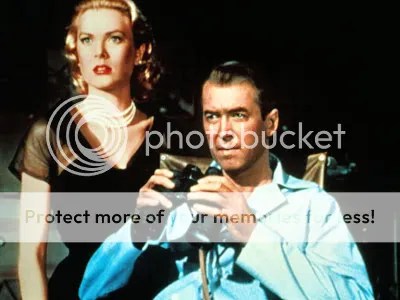 thriller or however you want to classify his films just don’t usually pique my interest. But when Stewart is involved all the sudden I tend to take a look. 1954’s Rear Window is one of Hitchcock’s tamer offerings and deals with voyeurism taking a rather minimalist approach. Stewart plays a photographer who is housebound by a broken leg in the midst of a scorching hot summer. With nothing better to do (television was around, but I guess he’s not interested), Jeff spends his time checking up on the neighbors in his courtyard apartment complex with the aid of his binoculars. He has a girlfriend (played by Grace Kelly) and a home health nurse, but he still spends a good bit of time bored and alone. He can’t help but form opinions about his neighbors as he clandestinely peeks into their lives, and he even gives them nicknames like Miss Lonelyhearts and Miss Torso. One neighbor in particular grabs his attention, a man named Thorwald (played by the future Perry Mason, Raymond Burr). Jeff becomes convinced that Thorwald has murdered his wife and tries to persuade the girlfriend, the nurse, and a police buddy. They are dismissive at first, but eventually the girlfriend starts to believe Jeff is right and even starts nosing around since he can’t. Thorwald catches on to the fact that he is being watched, and the climax is a confrontation between the two men. By today’s standards the action is rather docile, and even in the world of Hitchcock it is somewhat unremarkable. But that is exactly what I like about it. It isn’t fancy or complex and doesn’t need to be. A good steak doesn’t need any kind of accompaniment to cover up the taste…its flavor is good enough to speak for itself. Rear Window is a well written story with good actors that takes a simple but appealing concept and turns it into a jolly good piece of entertainment.
 I had to get to the point where I could admit that I liked a certain performer even if I disagree with their lifestyle. And so you will see movies on this list from the likes of Tom Hanks, Susan Sarandon, John Travolta, George Clooney, Brad Pitt, and Alec Baldwin. One of these assclowns is Tom Cruise, the king of some wackjob “religion” called Scientology. As a child of the 80’s I was a witness to the rise of Tom Cruise to superstardom, and I enjoyed most of his early films*- such as Taps, The Outsiders, Losin’ It, Cocktail, and of course Rain Man, Top Gun, & All the Right Moves. The past 10 years have been rather subpar though. Minority Report, Collateral, War of the Worlds, all those Mission: Impossible flicks?? I don’t think so. But back in 1996 Cruise got it exactly, 100%, so very right in what is at this point his last great movie. Jerry Maguire is a sports agent who has an epiphany about the rampant dishonesty and slimeyness inherent in his job. He writes a missive about these feelings and hands it out. He gets fired. Oops. With no other choice he ventures out on his own, but none of his clients follow him…except one. That lone client is Arizona Cardinals’ wide receiver Rod Tidwell (in an Oscar winning performance by Cuba Gooding Jr.), an eccentric, cocky, dissatisfied talent who just wants someone to “show me the money”. Also along for the ride is a secretary from Jerry’s former agency who is inspired to follow him and develops an infatuation. Dorothy is a single Mom of an extremely cute little boy, and Jerry develops a relationship with them after his shallow girlfriend dumps him. Sports fans get a small glimpse into the underhanded world of agent-client relations as well as enjoy cameos by such luminaries as NFL draft guru Mel Kiper Jr., quarterbacks Warren Moon, Troy Aikman, & Drew Bledsoe, sportscasters Al Michaels, Frank Gifford, & Mike Tirico, and real life sports agents Drew Rosenhaus & Leigh Steinberg. But the heart of the film is the romance between Jerry and Dorothy, a business arrangement that turns into something much deeper. 14 years later people still quote Jerry Maguire, and it’s delicate balance of comedy, drama, romance, and even a wee bit of action is a rare feat. It is sweet but not too sweet, cynical but not overly so. Writer-director Cameron Crowe, who also did Say Anything and Almost Famous, has a knack for making his characters very relatable and human. Jerry Maguire proves that a great movie doesn’t require guns ablazing, blood & guts, or special effects to be truly special.
 a mid 80’s film set in the early 50’s, which right off the bat gives it a timeless quality. It stars Gene Hackman as a former college basketball coach who, it is eventually revealed, lost his job after hitting a student. Coach Norman Dale has been out of the game for over a decade when he is thrown a bone by an old friend, the principal of a small Indiana high school in need of a coach. Anyone who knows basketball knows that it is especially revered in Indiana, and that is reflected in the story. There’s the usual conflict between the coach and his players, who just don’t understand his methods. Throw in a budding romance between the coach and a fellow teacher (who can’t stand each other at first of course), a town drunk who also happens to be a basketball guru (played by Dennis Hopper in an Academy Award nominated performance), a gifted but troubled player who is reluctant to join the team, and townsfolk who are just a bit too passionate about their team (overcompensating for their empty and meaningless lives of course) and you’ve got yourself a nicely layered movie. Hoosiers has all the typical clichés that were originated in Rocky and have become staples in sports films like Rudy, Tin Cup, Remember the Titans, and Major League. Hackman and Hopper give nice performances and Hoosiers is a more than decent flick. It’s a bit predictable and the characters could be flushed out a bit more (it’s less than 2 hours long…another 20 minutes would have been peachy), but there’s no denying it has a place amongst the great sports movies. That place just may be a little lower in my opinion than many others’.
 Everyman quality…nice guy, small towner, “aw shucks” attitude that draws fans to Stewart, but the truth is much more complex. Jimmy’s talents had many facets, and in his career he played diverse roles…small town nice guy, hardscrabble cowboy, sophisticated man-about-town. Three directors guided Stewart through a large chunk of his 92 films – Frank Capra (3 films), Anthony Mann (8 films) Alfred Hitchcock (4 films). It is his work with Hitchcock that, in my opinion, is the most unique. Vertigo is much like that book that you were assigned to read in school and really resisted, but upon being forced to read it you rather enjoyed. I am not normally a huge fan of the suspense thriller genre, and years ago when I first made myself watch Vertigo (afterall, any self respecting Stewart fan just HAS to), I was fully prepared to not really like it all that much. However, much to my surprise I was sucked in by the singular story and the mesmerizing performances. The plot is far too intricate to describe here, but suffice to say it involves deception, dual identities, murder, obsession, and of course vertigo (i.e. paralyzing fear of heights). Jimmy strays about as far away from the “aw shucks” nice guy persona as he would ever get, but doesn’t cross too far into villainous territory. Vertigo demands repeat viewing so one can digest all of Hitchcock’s twisted goodness, but it is time well spent…although I do recommend following it up with a screwball comedy as a palate cleanser.
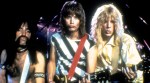 was made in 1984 by director Rob Reiner (fresh off his success as “Meathead” on All in the Family), and stars Michael McKean (Lenny from Laverne & Shirley), Christopher Guest, and Harry Shearer (known to 21st century audiences as the voice of Mr. Burns, Ned Flanders, Principal Skinner, and others on The Simpsons). Guest would go on to be a successful director of mockumentaries himself, as well as being the husband of 80’s scream queen and the still smokin’ hot Jamie Lee Curtis. This Is Spinal Tap follows a fictional British heavy metal band as they venture out on an American tour and includes flashbacks that tell the group’s backstory. Sharp eyed viewers will spot cameos or bit parts by now well known faces such as Paul Shaffer, Fred Willard, Fran Dresher, Dana Carvey, Anjelica Huston, and Billy Crystal, but it is the interaction of the three band members that makes the movie great. The band is…well…not that bright, which leads to hilarity. There are several iconic scenes that anyone who has ever seen the film will never forget…the amp that goes to 11, the spontaneous combustion and “unfortunate gardening accident “ (among other things) that continues to take the band’s revolving door of drummers, the Stonehenge set, the black album cover. And the songs – Spinal Tap produces songs with titles like Hell Hole, Sex Farm, Breakfast of Evil, and Swallow My Love. Basically This Is Spinal Tap takes everything we think we know about the awesomeness of the rock n’ roll lifestyle and throws it all out the window. You’ll never take rock music as seriously again, and that’s not a bad thing.
 identical timeframe as the original Star Trek series – who was in charge of TV shows in the 60’s and why did they keep cancelling great ones??) and was long gone before I was even born, but repeats were shown on some channel that I cannot recall when I was younger. Then in 1989, Tim Burton, who had achieved great success with Beetlejuice, decided to bring The Caped Crusader to the big screen. As I recall there was some trepidation with casting funnyman Michael Keaton in the titular role, but as it turns out he was perfect…much better than those who followed him – Val Kilmer and George Clooney. Of course the real star of this particular movie is Jack Nicholson as The Joker. I’ve never been a huge Nicholson fan…he’s more of a persona than a great actor…but he was the absolute best Joker. There are many that would say that the late Heath Ledger surpassed Nicholson’s achievement, but I feel like Ledger’s performance is too often looked at…subconsciously…through the prism of his untimely death. At any rate, all the stars aligned on this rendition of Batman on the big screen, and 20 years later it holds up quite nicely.
 boxer Jake Lamotta, in a film directed by the legendary Martin Scorcese, Deniro has a good story with which to work. He also has capable support from Joe Pesci in what was his first major film. I’m not a big boxing fan, but the acting and Scorcese’s style make this a modern classic. Maybe if I’d have been born a few years earlier or if I loved boxing as much as I do other sports Raging Bull would rank higher, as it does on most lists of this ilk. However, I must remain true to my own tastes and preferences, and this is where it falls on my spectrum.
 handpicked to fill an open seat in the U.S. Senate. He is chosen by a corrupt political machine who believes he can be easily manipulated so they can achieve their selfish goals. The villain in this complex web of deceit is the elder senator from Stewart’s state, played by Claud Rains, who is probably better known for playing the corrupt police official in Casablanca. Rains played the role of conflicted slimeball several times and was apparently quite good at it. I’m not sure how a Frenchman snagged the role of a United States Senator, and the fact that he doesn’t really make much of an effort to hide the accent is somewhat distracting. Adding support as a caustic adminstrative aide is Jean Arthur. She is assigned the task of babysitting the doe-eyed new Senator and gradually falls for him. The plotline specifics, in which Stewart’s character wants to build a “national boys’ camp” on land that, unbeknownst to him, Rains’ character has more nefarious and profitable plans in store, are not necessarily all that crucial. The film is about political corruption, and in its time it was groundbreaking. We’ve become a much more cynical nation now. But 70 years ago a movie that took such a dark view of the inner workings of our government was quite controversial. Stewart’s performance show’s his range. Over the course of his career, from lighthearted comedies like Harvey and The
  comedy…and doing it surprisingly well. Meet the Parents stars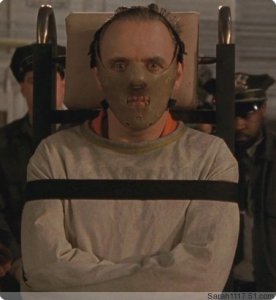


 The Manofesto